

How To Successfully Stock Your Pond!
In order to successfully stock your pond, there are some basic questions you need to answer. These include: How big is my pond? What is the water source and depth? What are my goals? And what permits are required? Once you’ve answered those questions, you can move on to the good stuff – choosing your fish!
How Big is My Pond?
This one is relatively straight forward but, is an important piece of information when considering pond management decisions. Appropriate fish stocking rates, pond care treatments, and aeration options are all influenced by your pond’s surface area. Measuring surface area can be as simple as multiplying the length times the width and dividing by 43,560 (the number of square feet per acre) for square or rectangular ponds. For example, a pond that measures 150′ x 100′ = 15,000 square feet which, when divided by 43,560 equals 0.34 acres.
For circular ponds, first measure the circumference, then square the circumference and divide by 547,390. For example, a pond with a circumference of 500′ would be calculated as follows: 500 x 500 = 250,000 which, divided by 547,390 equals 0.46 acres.
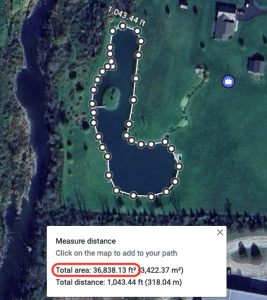
However, there’s another option available if your pond is oddly shaped or inaccessible or, if you just don’t feel like breaking out your tape measure and doing math! Here’s an easy way to calculate the approximate surface area of your pond using Google Maps:
- Enter the address of your pond, click on satellite view and locate your pond in the aerial image. Right click on the screen near the pond and from the drop-down menu, click on “measure
distance”.
- Click around the perimeter of the pond multiple times to outline it and end back at the original starting point. The lines between the dots can be adjusted by dragging them to make them more precise.

- Once the perimeter is closed, the “total area” will be displayed in square feet. Divide
this by 43,560 to get the surface area in acres. In the example above, the total area is 36,838 square feet or 0.85 acres.

What is the Water Source and Depth?
Water source and depth can help determine what species will be appropriate for your pond. For example, a deep, spring/stream fed pond might be appropriate for trout or walleye whereas, a shallower pond that is filled via runoff may get too warm in summer to support them.
Generally speaking, ponds in excess of 15′ deep will maintain a reservoir of cold water in the bottom that will provide good habitat for cold water species through the summer months. This can vary though if your spring/stream dries up or your water level drops when it gets warm.
Shallower ponds will be more well suited to species that are tolerant of warmer water such as bass, bluegill, and catfish. To learn more about the temperature requirements of each species, checkout the description associated with each one on the Fish page of the website, for example: Rainbow Trout which are best suited for ponds that remain 70 degrees or below year round.
Ultimately, some seasonal observation combined with a little trial and error may be what’s required to get the right mix. If you’re unsure though, it’s usually best to error on the side of caution and stick with warm water species or, to put in small number of cold water species to start and then increase the quantity if they make it through the first summer.
What Are My Goals
Goals can vary significantly from one pond owner to the next and will often dictate your approach to stocking. More casual pond owners may want to stock fish to kick start the ecosystem or provide mosquito control but have little interest in fishing. In that case, species that are relatively self sufficient such as minnows, bass, and bluegill might be appropriate. Others may be interested in providing entertainment for their kids/grandchildren while hardcore fishing enthusiasts may be trying to grow trophy bass. As long as the habitat is appropriate for the species, there is no right answer when it comes to what you should stock. Ultimately, the mix of species you end up with will be based on your interests and future plans for your pond so, don’t let every article on the internet or fisherman you know tell you what is best, only you can decide.
What Are Your Regulations
Some states require a stocking permit to put any species of fish in your pond while others only require permits for specific species such as grass carp. For a lists of permit applications, checkout the Permits page of the website. If you’re still unsure, you can always Contact Us or your local Soil and Water Conservation District for guidance
Choosing Your Fish
Ahhh, the fun begins! Choosing your fish is probably the best part of stocking your pond! If you’ve checked off the steps above and are unsure what you fish you should choose, we can help. If you already know and are just looking to order your fish, you can go ahead and place your order today! Here are a few other tips to help you round it out:
Fathead Minnows: Regardless of what your plans are for your pond, we always recommend stocking minnows. Minnows not only provide forage for larger game species but, they also help to control insects around your pond by eating larvae such as mosquitos!
Largemouth Bass: We have a Bass Pond Package which is a great way to establish fish in a new pond or supplement quantities in an existing pond. The Bass Pond Package is ideal for ponds that vary in temperature or depth throughout the year since the species in this package are tolerant of a wide range of environmental variables. By ordering a package you are also receiving a quantity discount. This package includes largemouth bass, fathead minnows, bluegill sunfish, and channel catfish. If you don’t want to go with the package, you can order bass individually, just don’t forget the minnows for feed! Black crappie, yellow perch and walleye also make great cohabitants for largemouth. Side note: walleye are primarily nocturnal and yellow perch, which coincidentally see very poorly at night, are the preferred forage for walleye. Therefore it is highly recommended that if you choose to stock walleye you also stock yellow perch or have an existing population to support your walleye!
Rainbow Trout: We also have a great Trout Pond Package that is ideal for ponds that remain consistently cool (below 70 degrees F at some depth). This package includes fathead minnows, channel catfish and rainbow trout.
Add Some Furniture
Fish love structure! If you built your pond and are looking to provide the best possible habitat to ensure your fish will THRIVE you may want to consider adding some of our premade fish habitats. Many trophy bass fisheries like Lake Fork, Toledo Bend, and Fellsmere Reservoir have hundreds of these. Fish Habitats provide ambush points for your trophy sport fish and protection for your forage and fry. These products are made of recycled material that will not decompose and feature natural colors, textured surfaces, and flexible limbs.

Fish Habitats:
- Can hang from a dock or pier vertically.
- Can be placed on the bottom of a lake or pond horizontally.
- Are great for use at any depth.
- Can be clustered together to create a long-lasting brush pile.
- Are easy to assemble.
ORDER TODAY!
We hope this will help you successfully stock your pond, regardless of your goal. If you have any questions please reach out – we’d love to hear from you!