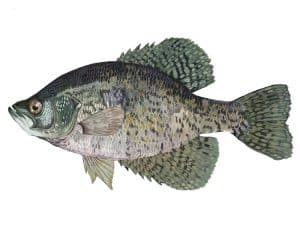

Bluegill Sunfish
$3.95
| Name | Bluegill Sunfish (Lepomis macrochirus) |
| Size | 3-5" |
| Availability | April-November |
| Stocking Rate | up to 300/acre |
| Quantity Pricing | 1-49: $3.95 each 50-99: $3.55 each 100+: $3.15 each |
UPS Next Day Air® Fish shipments are sent out every Wednesday, weather permitting. Please note that the cutoff time each week is Tuesday at 5pm. Orders received after this deadline will be shipped the following week.
Bluegill Sunfish are native to most of North America and are popular feed and sport fish. They can be found in many small ponds and are easily identified by the black spot visible on their gill plate in conjunction with the dark vertical bars on their sides. Bluegills will swim in schools of 20-30 individuals and prefer calm water with abundant cover such as weed beds, docks, logs and lily pads. Feed usually consists of insects, small crustaceans and some plant material. Full grown fish will average 6-8 inches. Males will construct a saucer shaped nest approximately 2-3 inches deep and 1-2 feet in diameter. Spawning occurs in the spring and summer when water temperatures reach 70-80 degrees F.
NOTE ON SHIPPING FISH: If you would like us to ship your fish directly to you, you must be within the following states: Connecticut, Delaware, Maryland, New Jersey, New York, North Carolina, Ohio, Pennsylvania, Virginia, or West Virginia. Fish will only ship during the available season. Shipping is calculated at checkout and only offered via UPS overnight.
Frequently Asked Questions
How many bluegill should I stock per acre?
We recommend up to 300 bluegill sunfish per acre. Our 3-5 inch fish establish quickly and, once water reaches 70-80°F, spawn through spring and summer to build your pond's forage base.
Will bluegill overpopulate my pond?
Not in a balanced pond - adequate bass predation keeps bluegill numbers in check. Overpopulation usually points to too few predators, not a bluegill problem. Pairing up to 300 bluegill with up to 100 bass per acre maintains the balance.
How big do bluegill get?
Full-grown bluegill average 6-8 inches. They travel in schools of 20-30 and favor calm water with cover - weed beds, docks, logs, and lily pads - where they feed on insects and small crustaceans. They are outstanding sport on light tackle.
When are bluegill available?
April through November, excluding July-August when we pause fish transport due to heat. Spring stockings typically spawn the same season.
How do I get live bluegill from Mid-Atlantic Stocking?
Three ways: free pickup at a scheduled delivery-route stop (routes run roughly monthly, April-October), UPS Next Day Air shipping every Wednesday (order by Tuesday 5 PM) to CT, DE, MD, NC, NJ, NY, OH, PA, VA & WV, or direct-to-pond delivery by quote. Fish are packaged with water and pure oxygen.
What if some fish do not survive the trip?
All our fish are certified disease-free, and we replace any mortality over 5% - in transit, or within 48 hours of introduction when the acclimation directions are followed. Document losses with photos and file a Mortality Report on our website.
Additional information
| Weight | 0.5 lbs |
|---|---|
| Dimensions | 1 × 1 × 1 in |
How Many Bluegill Should You Stock?
We recommend stocking up to 300 bluegill per surface acre. Use the table below to find the right quantity for your pond. These numbers assume a new or recently renovated pond — if you already have an existing bluegill population, contact us for a custom recommendation.
| Pond Size | Recommended Qty | Notes |
|---|---|---|
| ¼ acre | 75 | Ideal foundation for a bass-bluegill pond |
| ½ acre | 150 | Pair with 50 bass after forage is established |
| 1 acre | 300 | Pair with up to 100 bass and fathead minnows |
| 2 acres | 600 | Pair with up to 200 bass and fathead minnows |
| 5 acres | 1,500 | Contact us for large-order pricing |
| 10 acres | 3,000 | Contact us for large-order pricing & delivery |
Based on a maximum stocking rate of 300 bluegill per surface acre. Quantities may vary depending on existing fish populations, pond structure, and management goals.
Stocking Sequence & Timing
In a new bass-bluegill pond, stock fathead minnows first, then add bluegill 4–6 weeks later, and introduce bass 6–12 months after that. Getting this sequence right is one of the most important factors in building a healthy, productive pond.
- Fathead minnows go in first to establish an immediate forage base. They reproduce quickly (spawning 5–6 times per summer), giving your pond a strong food foundation before you add anything else.
- Add bluegill 4–6 weeks after minnows. This gives the minnows time to settle in and begin reproducing. Bluegill are your second forage layer and will spawn once water reaches 70–80°F (typically June through August), so spring-stocked bluegill can reproduce that same season.
- Introduce bass 6–12 months after bluegill. By this point, both forage species have spawned and built up numbers. Bass stocked into a pond with an established forage population grow significantly faster and reach trophy size sooner.
Want to skip the wait? Our Bass Pond Package includes fathead minnows (1–2″), bluegill (3–5″), channel catfish (4–6″), and largemouth bass (4–6″) at staggered sizes for ¼- to 1-acre ponds. The minnows provide immediate forage while your game fish grow into the pond — a convenient single-delivery option when the staggered approach isn’t practical.
Best stocking windows: Spring (April through June) is our most popular window; fall (September through October) is great for getting established before winter. We do ship and deliver fish during July and August when temperatures permit.
Trout pond owners: Bluegill can coexist with trout in larger ponds, but they may compete for food and space in smaller ones. If you maintain a trout pond, we recommend consulting with us before adding bluegill.
State Stocking Permits
Most Mid-Atlantic states require a fish stocking permit before introducing bluegill (or any fish) into your pond. We can help you navigate the process — visit our Permits page for your state’s application, or contact us with questions.