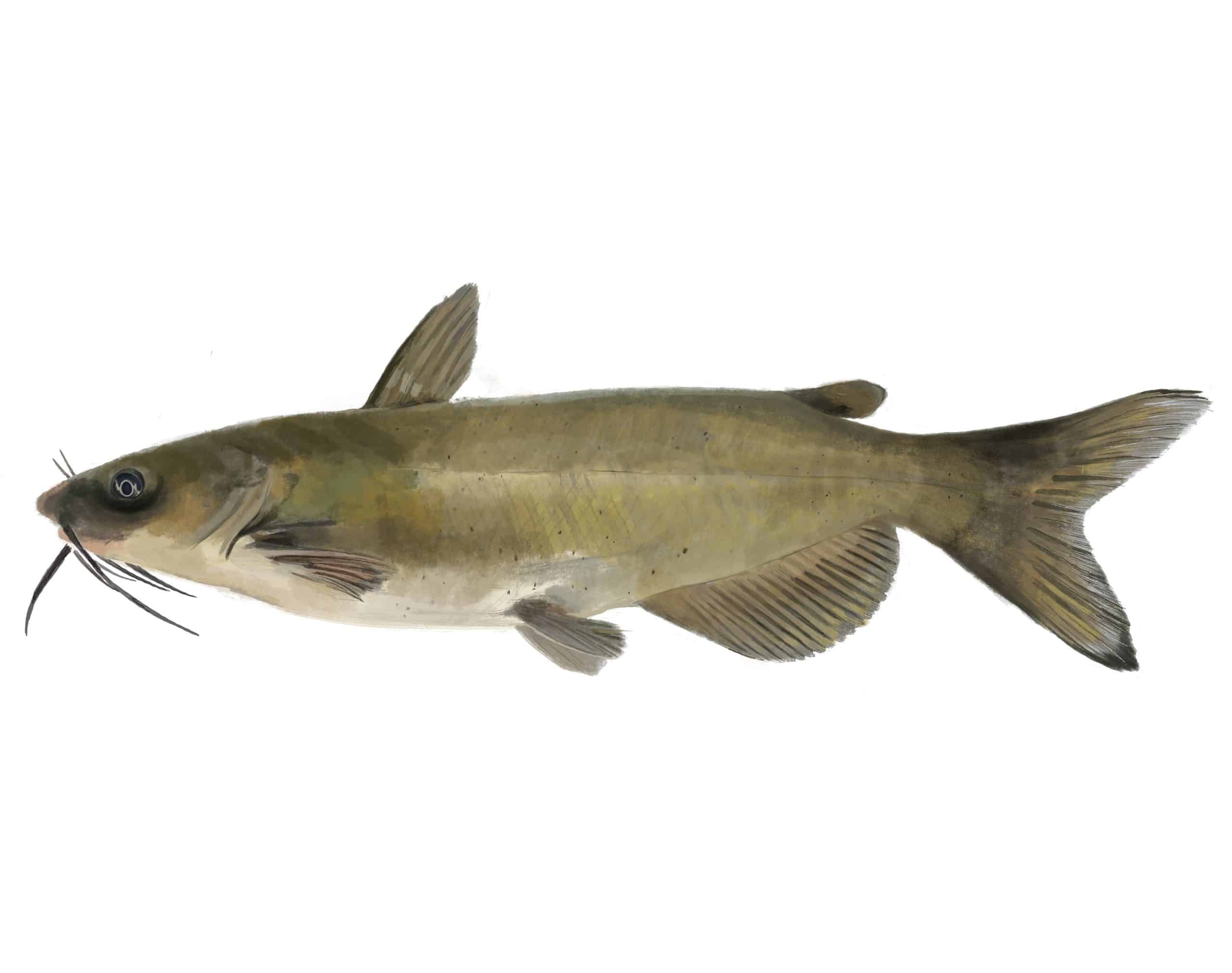
Channel Catfish
$3.95
| Name | Channel Catfish (Ictalurus punctatus) |
| Size | 4-6" |
| Availability | April-November |
| Stocking Rate | up to 200/acre |
| Quantity Pricing | 1-49: $3.95 each 50-99: $3.55 each 100+: $3.15 each |
UPS Next Day Air® Fish shipments are sent out every Wednesday, weather permitting. Please note that the cutoff time each week is Tuesday at 5pm. Orders received after this deadline will be shipped the following week.
Channel Catfish are the most sought after member of the catfish family, providing excitement by striking at both bait and artificial lures. It is distinguished from other members of the catfish family by its forked tail and the black spots visible along its sides. Channel Catfish will not muddy a pond like its cousin the Bullhead, making it preferable for stocking in those environments. They average from 2-5 pounds, and have been commonly caught over 20 pounds. Feed consists of fish, insects, crustaceans or commercial fish food. Spawning will occur when the water temperature reaches 70 degrees F, usually under a log or stone, but pipe segments or cans over 8 inches in diameter can provide an artificial medium for spawning as well.
NOTE ON SHIPPING FISH: If you would like us to ship your fish directly to you, you must be within the following states: Connecticut, Delaware, Maryland, New Jersey, New York, North Carolina, Ohio, Pennsylvania, Virginia, or West Virginia. Fish will only ship during the available season. Shipping is calculated at checkout and only offered via UPS overnight.
Frequently Asked Questions
How many channel catfish should I stock per acre?
We recommend up to 200 channel catfish per acre. Our fish are 4-6 inch fingerlings that grow quickly on a diet of fish, insects, crustaceans, or commercial feed.
Will channel catfish muddy my pond or take it over?
No - unlike their bullhead cousins, channel catfish will not muddy a pond. They spawn only where cavity structure exists (logs, stones, or pipes over 8 inches in diameter), so their numbers stay easy to manage; most owners simply restock as fish are harvested.
How big do channel catfish get?
Pond channel catfish average 2-5 pounds, and fish over 20 pounds are commonly caught. They strike both bait and artificial lures, making them one of the most exciting fish in a pond. Feeding a floating commercial feed accelerates growth.
When are channel catfish available?
April through November, with no fish transport during July-August. They spawn once water reaches 70°F.
How do I get live channel catfish from Mid-Atlantic Stocking?
Three ways: free pickup at a scheduled delivery-route stop (routes run roughly monthly, April-October), UPS Next Day Air shipping every Wednesday (order by Tuesday 5 PM) to CT, DE, MD, NC, NJ, NY, OH, PA, VA & WV, or direct-to-pond delivery by quote. Fish are packaged with water and pure oxygen.
What if some fish do not survive the trip?
All our fish are certified disease-free, and we replace any mortality over 5% - in transit, or within 48 hours of introduction when the acclimation directions are followed. Document losses with photos and file a Mortality Report on our website.
Additional information
| Weight | 0.5 lbs |
|---|---|
| Dimensions | 1 × 1 × 1 in |
| Quantity | 1-49, 50-99, 100+ |
Pond-Size Stocking Guide
Recommended channel catfish quantities based on a stocking rate of up to 200 fish per acre.
| Pond Size | Recommended Qty | Notes |
|---|---|---|
| ¼ acre | 50 | Great for a catfish-only or mixed-species pond |
| ½ acre | 100 | Works well alongside bass and bluegill |
| 1 acre | 200 | Pair with bass, bluegill, and fathead minnows for a balanced ecosystem |
| 2 acres | 400 | Pair with bass, bluegill, and fathead minnows |
| 5 acres | 1,000 | Contact us for large-order pricing |
| 10 acres | 2,000 | Contact us for large-order pricing and delivery |
Higher-density stocking: For catfish-only ponds stocked above 200 per acre, supplemental feeding with commercial fish feed is recommended to support healthy growth.
When and How to Stock Channel Catfish
- Flexible timing: Channel catfish are versatile — they can be added to new or established ponds at any point during the April–November season.
- Adding to a bass-bluegill pond: In a new pond, the ideal sequence is fathead minnows first, bluegill 4–6 weeks later, then catfish and bass 6–12 months after that. Catfish are bottom feeders and occupy a different niche than bass and bluegill, so they complement rather than compete with those species. In an established pond, catfish can be added at any time.
- Skip the wait with a package: Our Bass Pond Package includes fathead minnows (1–2″), bluegill (3–5″), channel catfish (4–6″), and largemouth bass (4–6″) sized for ¼- to 1-acre ponds. The minnows provide immediate forage while your game fish grow into the pond — a convenient single-delivery option.
- Encouraging natural reproduction: Spawning occurs when water reaches 70°F. Providing pipe segments or hollow logs (8″+ diameter) in 2–3 feet of water gives catfish the sheltered cavities they need for nesting.
- Put-and-take fishing: Stock in spring for summer harvest. Channel catfish readily take both bait and artificial lures, making them a favorite for recreational ponds.
- Supplemental feeding: Commercial fish feed accelerates growth significantly. Catfish trained on pellets will grow faster than those relying on natural forage alone.
State Stocking Permits
Most Mid-Atlantic states require a fish stocking permit before introducing channel catfish into your pond. We can help you navigate the process — visit our Permits page for your state’s application, or contact us with questions.